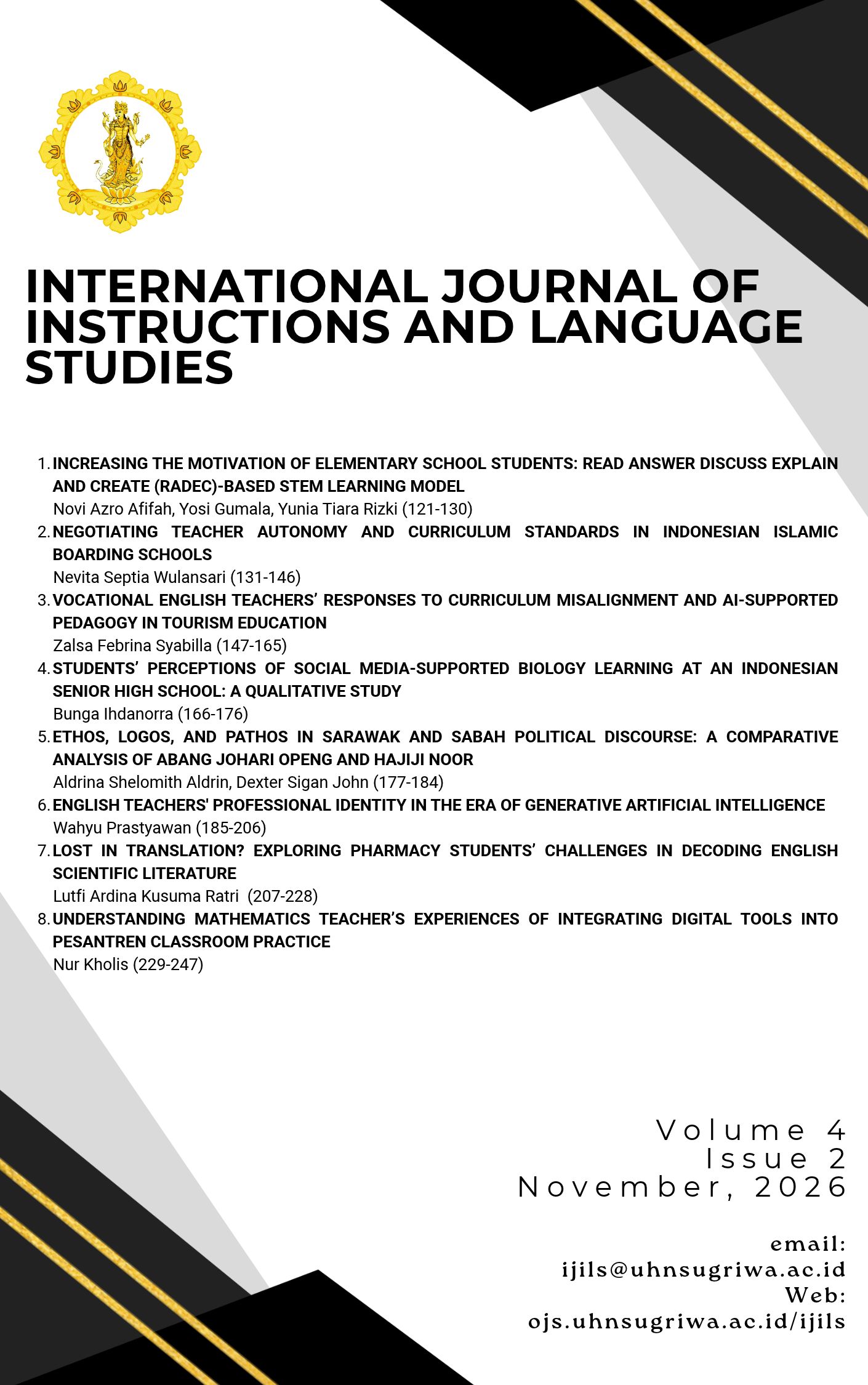
ENGLISH TEACHERS' PROFESSIONAL IDENTITY IN THE ERA OF GENERATIVE ARTIFICIAL INTELLIGENCE
Keywords:
teacher professional identity, English language teaching, Generative Artificial Intelligence, human–AI collaboration, professional developmentAbstract
The rapid advancement of Generative Artificial Intelligence (GenAI) has transformed educational practices and redefined the professional roles of English teachers. While previous studies have primarily focused on the pedagogical applications of AI, limited attention has been given to how English teachers construct and negotiate their professional identity in AI-enhanced educational environments. This study explores English teachers' professional identity in the era of Generative Artificial Intelligence through a qualitative narrative inquiry approach. Ten English teachers from public and private senior high schools in East Java, Indonesia, were purposively selected based on their experience integrating Generative AI into English language teaching. Data were collected through semi-structured, in-depth interviews and analyzed using Braun and Clarke's thematic analysis. The findings revealed three major themes: (1) reconstructing professional identity through AI-enhanced pedagogy, in which teachers redefined their roles from knowledge transmitters to learning designers, facilitators, and critical evaluators; (2) negotiating professional agency in human–AI collaboration, highlighting teachers' efforts to balance AI utilization with pedagogical judgment, ethical responsibility, and the promotion of students' critical thinking; and (3) embracing lifelong professional learning amid AI transformation, demonstrating teachers' commitment to continuously developing AI literacy and digital pedagogical competence. The findings indicate that Generative AI does not replace English teachers but reshapes their professional identity by emphasizing uniquely human capacities, including pedagogical reasoning, contextual decision-making, ethical leadership, and interpersonal engagement. This study contributes to the emerging literature on teacher professional identity by positioning AI integration as an identity-related process rather than merely a technological innovation. The findings further suggest that teacher education programs and professional development initiatives should prioritize identity development, critical AI literacy, and ethical AI integration to support sustainable English language teaching in the age of artificial intelligence.
Downloads
Published
Issue
Section
License
Copyright (c) 2026 Wahyu Prastyawan

This work is licensed under a Creative Commons Attribution-NonCommercial-ShareAlike 4.0 International License.