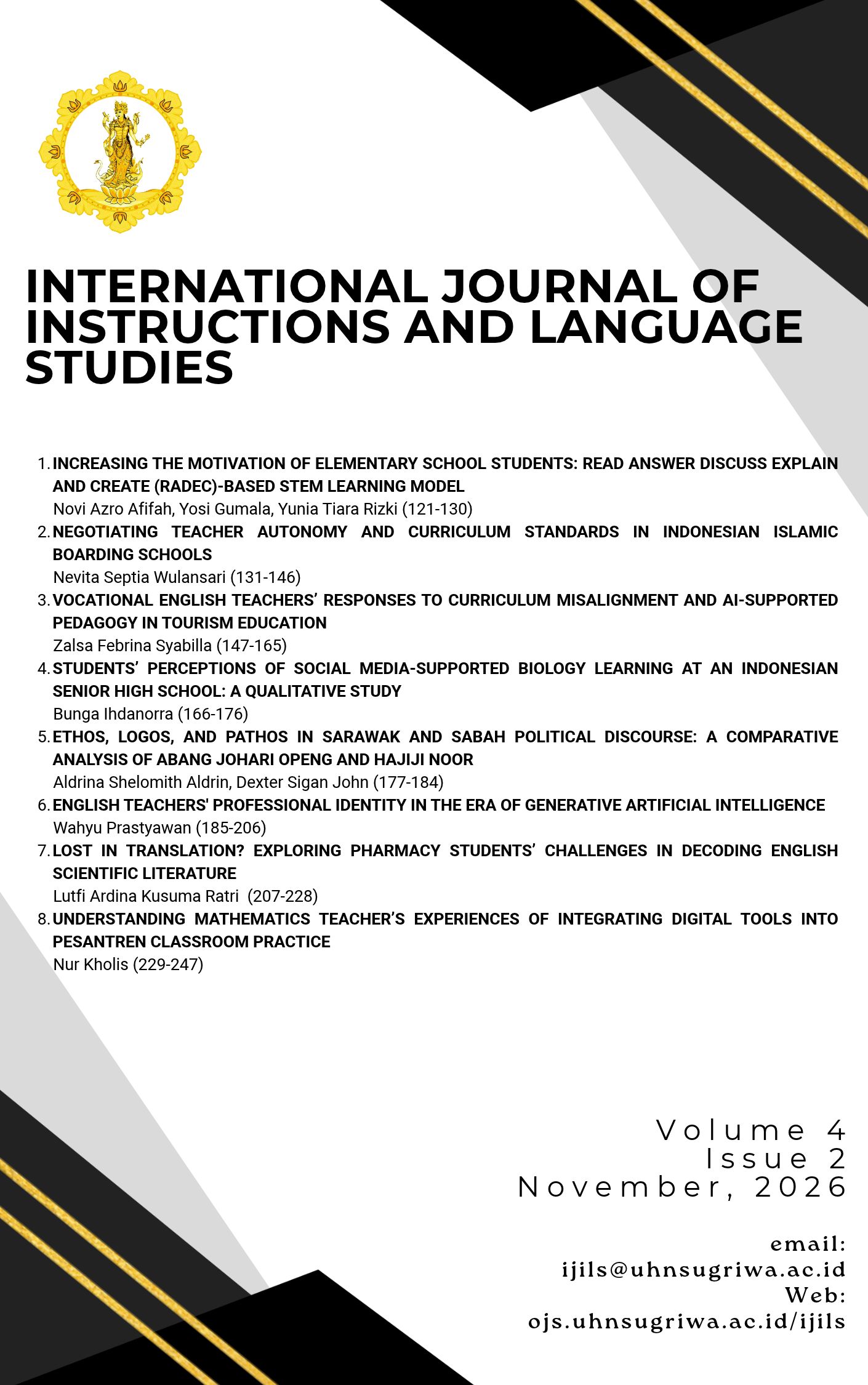
UNDERSTANDING MATHEMATICS TEACHER’S EXPERIENCES OF INTEGRATING DIGITAL TOOLS INTO PESANTREN CLASSROOM PRACTICE
Keywords:
Digital Technology Integration, Mathematics Education, Narrative Inquiry, Pesantren, Teacher experiencesAbstract
The integration of digital technology has transformed mathematics education; however, little is known about how mathematics teachers experience this transformation within Islamic boarding schools (pesantren), where technological innovation must be balanced with religious and cultural values. This study aimed to explore a mathematics teacher's lived experiences of integrating digital tools into classroom practice in a private pesantren in Pasuruan, East Java, Indonesia. A qualitative narrative inquiry design was employed to capture the participant's professional journey and instructional experiences. The participant was a mathematics teacher who has taught since 2019. Data were collected through three semi-structured, in-depth interviews conducted between May and July 2026 and analyzed using Connelly and Clandinin's narrative inquiry framework, emphasizing temporality, sociality, and place. The findings revealed that digital tools, including GeoGebra, Desmos, Google Classroom, and AI-assisted applications, enhanced students' conceptual understanding, visualization, engagement, and participation in mathematics learning. However, the participant also encountered challenges related to limited technological infrastructure, unequal student digital literacy, rapid technological change, and the need to align digital innovation with pesantren educational values. To address these challenges, the teacher adopted strategies such as continuous self-directed professional learning, collaboration with colleagues, gradual implementation of digital applications, and careful selection of technologies appropriate to instructional objectives and institutional culture. The study concludes that successful digital technology integration in pesantren mathematics classrooms depends not only on access to technology but also on teachers' pedagogical competence, contextual adaptation, and reflective professional practice. These findings contribute to the growing literature on contextualized technology integration and provide practical implications for teacher professional development and digital transformation within Islamic educational institutions.
Downloads
Published
Issue
Section
License
Copyright (c) 2026 Nur Kholis

This work is licensed under a Creative Commons Attribution-NonCommercial-ShareAlike 4.0 International License.