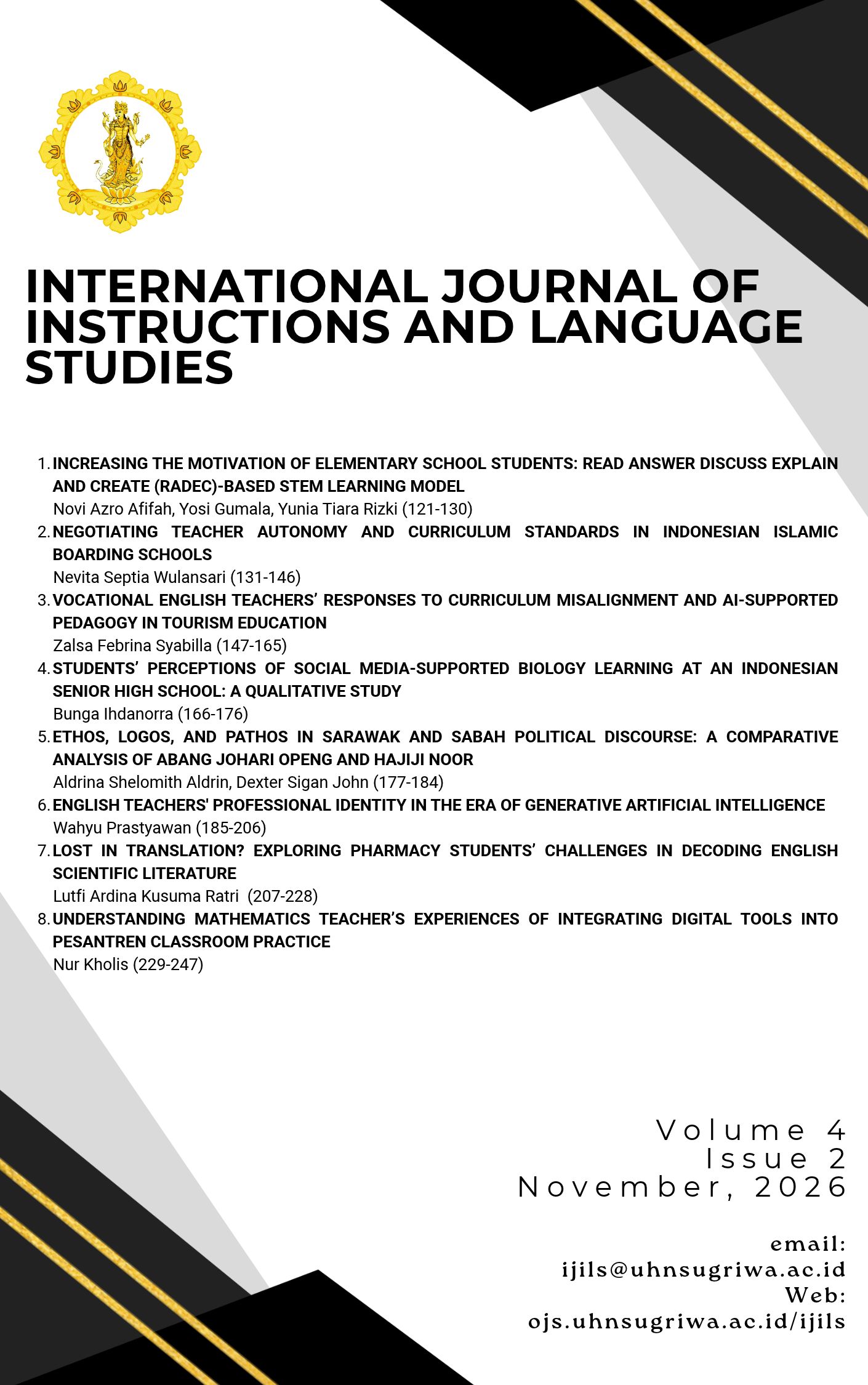
LOST IN TRANSLATION? EXPLORING PHARMACY STUDENTS’ CHALLENGES IN DECODING ENGLISH SCIENTIFIC LITERATURE
Keywords:
English for Pharmacy Purposes, English scientific literature, pharmacy students, scientific reading, self-regulated learningAbstract
The ability to comprehend English scientific literature is an essential competency for pharmacy students, as evidence-based pharmaceutical practice relies heavily on accessing and interpreting international research. However, many English as a Foreign Language (EFL) learners continue to experience considerable difficulties when engaging with authentic scientific articles. This study aimed to explore the challenges encountered by Indonesian pharmacy students in reading English scientific literature, identify the factors contributing to these difficulties, and examine the strategies they employ to overcome them. A qualitative case study design was adopted. Data were collected through semi-structured interviews with five undergraduate pharmacy students at a private university in Surakarta, Indonesia, and analyzed using Braun and Clarke’s thematic analysis. The findings revealed three major themes. First, students experienced multidimensional challenges, including unfamiliar pharmaceutical terminology, complex grammatical structures, dense academic discourse, difficulties interpreting research methodology and statistical information, and limited comprehension of the overall arguments presented in scientific articles. Second, these challenges were shaped by the interaction of linguistic, cognitive, and disciplinary factors, indicating that successful scientific reading requires more than general English proficiency. Third, participants adopted various self-regulated learning strategies, including utilizing digital translation and learning tools, applying repeated reading and note-taking techniques, and seeking support from peers and lecturers to enhance comprehension. The study highlights the need for integrated English for Pharmacy Purposes (EPP) instruction that combines discipline-specific vocabulary development, scientific reading strategies, research literacy, and technology-supported learning. These findings contribute to the growing literature on English for Specific Purposes by providing empirical insights into scientific reading challenges within Indonesian pharmacy education.
Downloads
Published
Issue
Section
License
Copyright (c) 2026 Lutfi Ardina Kusuma Ratri

This work is licensed under a Creative Commons Attribution-NonCommercial-ShareAlike 4.0 International License.