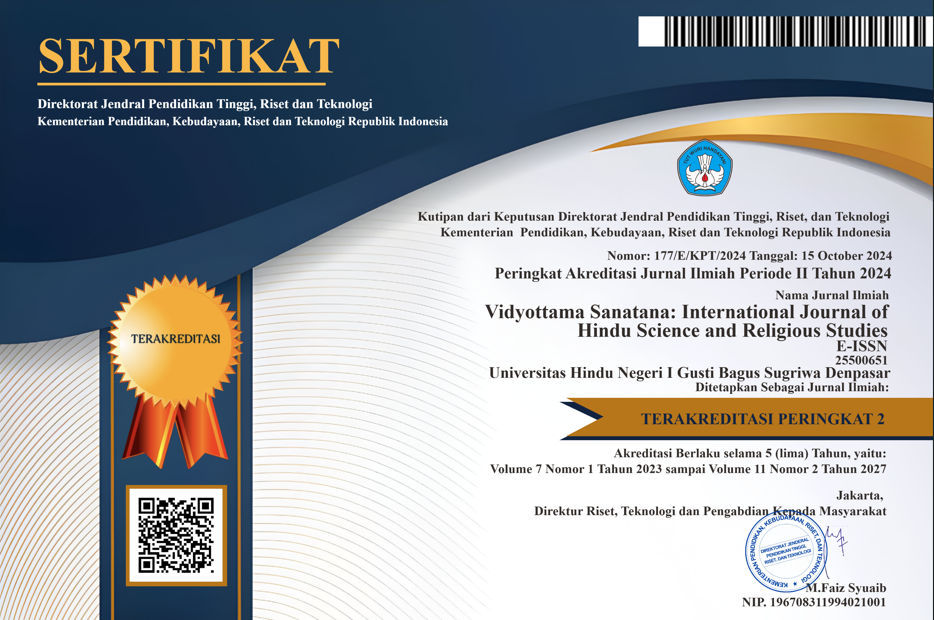
LIVING WITH TRAUMA: AN INTERPRETATIVE PHENOMENOLOGICAL ANALYSIS OF A HINDU’S RESILIENCE AFTER NATURAL DISASTERS IN SIGI BIROMARU
DOI:
https://doi.org/10.25078/vidyottama.v9i1.4687Keywords:
Emotional Resilience, Interpretative Phenomenological Analysis, Natural Disasters, Posttraumatic Stress Disorder, Spiritual ResilienceAbstract
The natural disasters that struck the Sigi Biromaru area resulted in PTSD (posttraumatic stress disorder), as experienced by a Hindu survivor. Nevertheless, he organised resilience that focused on emotional and spiritual concerns. This research aimed to investigate a Hindu survivor’s resilience after natural disasters in Sigi Biromaru. Based on qualitative methods utilised the interpretative phenomenological analysis (IPA) approach, this research identified three main themes: traumatic experiences, emotional resilience, and spiritual resilience. The research evidenced that the participant has emotional and spiritual resilience as a foundation for overcoming trauma. Emotional resilience is when the survivor can deal with traumatic experiences by developing skills that support emotional balance, such as engaging in positive activities, pursuing hobbies and maintaining a healthy mindset. In addition, spiritual resilience, such as belief in God, praying and giving alms, is important in strengthening theological, psychological and sociological balance. Ultimately, this research contributes to an understanding of the strength of emotional and spiritual resilience that plays a role in shaping the spirit to survive and continue life of an individual who is still experiencing trauma, as well as its implications in the context of handling trauma after natural disasters.
References
AbdAleati, N. S., Zaharim, N. M., & Mydin, Y. O. (2016). Religiousness and Mental Health: Systematic Review Study. Journal of Religion and Health, 55, 1929–1937. https://doi.org/10.1007/s10943-014-9896-1
Agarwal, K., Fortune, L., Heintzman, J. C., & Kelly, L. L. (2020). Spiritual Experiences of Long-Term Meditation Practitioners Diagnosed with Breast Cancer: An Interpretative Phenomenological Analysis Pilot Study. Journal of Religion and Health, 59(5), 2364–2380. https://doi.org/10.1007/s10943-020-00995-9
Agarwal, K., Kelly, L. L., Heintzman, J. C., & Fortune, L. D. (2022). Lived Spiritual Experiences of Cancer Survivors with Long-term Meditation Practices: An Interpretative Phenomenological Analysis. Pastoral Psychology, 71, 485–501. https://doi.org/10.1007/s11089-022-01014-2
Arif, A. M. (2024). Learning Model for Natural Disaster Mitigation Based on Local Wisdom. QALAMUNA: Jurnal Pendidikan, Sosial, Dan Agama, 16(1), 255–264. https://doi.org/10.37680/qalamuna.v16i1.4412
D’Errico, D., & Hunt, N. (2022). Place responsiveness: IPA walking interviews to explore participants’ responses to natural disasters. Qualitative Research in Psychology, 19(2), 346–359. https://doi.org/10.1080/14780887.2019.1604929
Darlis, Jusmiati, Punawan, A. S. bin, & Talebe, T. (2020). Quran as A Trauma Healer for Community Victims of Earthquake and Lequification in Palu Municipality. Al-Ulum, 20(2), 407–424. https://doi.org/10.30603/au.v20i2.1698
Davis, M. C. (2009). Building Emotional Resilience to Promote Health. American Journal of Lifestyle Medicine, 3(1_suppl), 60S-63S. https://doi.org/10.1177/1559827609335152
Dein, S. (2020). Religious healing and mental health. Mental Health, Religion and Culture, 23(8), 657–665. https://doi.org/10.1080/13674676.2020.1834220
Eatough, V., & Smith, J. A. (2006). I was like a wild wild person: Understanding feelings of anger using interpretative phenomenological analysis. British Journal of Psychology, 97(4), 483–498. https://doi.org/10.1348/000712606X97831
Exline, J. J., Smyth, J. M., Gregory, J., Hockemeyer, J., & Tulloch, H. (2005). Religious Framing by Individuals With PTSD When Writing About Traumatic Experiences. The International Journal for the Psychology of Religion, 15(1), 17–33. https://doi.org/10.1207/s15327582ijpr1501_2
Farooqui, M., Quadri, S. A., Suriya, S. S., Khan, M. A., Ovais, M., Sohail, Z., Shoaib, S., Tohid, H., & Hassan, M. (2017). Posttraumatic stress disorder: a serious post-earthquake complication. Trends in Psychiatry and Psychotherapy, 39(2), 135–143. https://doi.org/10.1590/2237-6089-2016-0029
Fisher, J. (2013). You can’t beat relating with god for spiritual well-being: Comparing a generic version with the original spiritual well-being questionnaire called SHALOM. Religions, 4(3), 325–335. https://doi.org/10.3390/rel4030325
Futterman, I. D., Grace, H., Weingarten, S., Borjian, A., & Clare, C. A. (2023). Maternal anxiety, depression and posttraumatic stress disorder (PTSD) after natural disasters: a systematic review. Journal of Maternal-Fetal and Neonatal Medicine, 36(1). https://doi.org/10.1080/14767058.2023.2199345
Gairola, V., & Singh, K. (2023). Positive Practices Within Hinduism. In K. Singh & G. Saxena (Eds.), Religious and Spiritual Practices in India: A Positive Psychological Perspective (pp. 47–67). https://doi.org/10.1007/978-981-99-2397-7_3
Geraldi Gauci, M. (2019). WASP (Write a Scientific Paper): Interpretative phenomenological analysis: Its attraction and relevance to the medical field. Early Human Development, 133, 52–56. https://doi.org/10.1016/j.earlhumdev.2019.03.012
Herrman, H. (2012). Promoting mental health and resilience after a disaster. Journal of Experimental and Clinical Medicine, 4(2), 82–87. https://doi.org/10.1016/j.jecm.2012.01.003
Herrman, H., Stewart, D. E., Diaz-Granados, N., Berger, E. L., Jackson, B., & Yuen, T. (2011). What is resilience? The Canadian Journal of Psychiatry, 56(5), 258–265. https://doi.org/10.1177/070674371105600504
Horn, S. R., & Feder, A. (2018). Understanding Resilience and Preventing and Treating PTSD. Harvard Review of Psychiatry, 26(3), 158–174. https://doi.org/10.1097/HRP.0000000000000194
Kang, C. (2010). Hinduism and mental health: Engaging British Hindus. Mental Health, Religion and Culture, 13(6), 587–593. https://doi.org/10.1080/13674676.2010.488427
Khairil, M., Alatas, R., Sari, D. F. K., & Mirfath. (2020). Communication strategy using Da’wah assembly to heal traumatised natural disaster victims in Palu City. Space and Culture, India, 7(4), 228–233. https://doi.org/10.20896/SACI.V7I4.626
Kim, S. H., Schneider, S. M., Kravitz, L., Mermier, C., & Burge, M. R. (2013). Mind-Body Practices for Posttraumatic Stress Disorder. Journal of Investigative Medicine, 61(5), 827–834. https://doi.org/10.2310/JIM.0b013e3182906862
Kusumastuti, R. D., Viverita, Husodo, Z. A., Suardi, L., & Danarsari, D. N. (2014). Developing a resilience index towards natural disasters in Indonesia. International Journal of Disaster Risk Reduction, 10, 327–340. https://doi.org/10.1016/j.ijdrr.2014.10.007
Lawrence, V. A., & Lee, D. (2014). An Exploration of People’s Experiences of Compassion-focused Therapy for Trauma, Using Interpretative Phenomenological Analysis. Clinical Psychology & Psychotherapy, 21(6), 495–507. https://doi.org/10.1002/cpp.1854
Li, Z., Dai, J., Wu, N., Jia, Y., Gao, J., & Fu, H. (2019). Effect of long working hours on depression and mental well-being among employees in Shanghai: The role of having leisure hobbies. International Journal of Environmental Research and Public Health, 16(24). https://doi.org/10.3390/ijerph16244980
Murden, F., Bailey, D., Mackenzie, F., Oeppen, R. S., & Brennan, P. A. (2018). The impact and effect of emotional resilience on performance: an overview for surgeons and other healthcare professionals. British Journal of Oral and Maxillofacial Surgery, 56(9), 786–790. https://doi.org/10.1016/j.bjoms.2018.08.012
Murphy, J., Jones, F. W., & Nigbur, D. (2022). ‘I Believe in Something; I Don’t Know What It Is’: An Exploration of Five British Hindus’ Worldviews Using Interpretative Phenomenological Analysis. Secularism and Nonreligion, 11(4), 1–14. https://doi.org/10.5334/snr.160
Nasri, R. I., Seniwati, T., Ilkafah, & Erfina, E. (2020). Screening of post-traumatic stress disorder (PTSD) among flood victims in Indonesia. Enfermería Clínica, 30(2), 345–349. https://doi.org/10.1016/j.enfcli.2019.07.115
Nizza, I. E., Smith, J. A., & Kirkham, J. A. (2017). ‘Put the illness in a box’: a longitudinal interpretative phenomenological analysis of changes in a sufferer’s pictorial representations of pain following participation in a pain management programme. British Journal of Pain, 12(3), 163–170. https://doi.org/10.1177/2049463717738804
Nole, O. A. (2023). Pengalaman Mahasiswa Rantau tentang Adaptasi Lintas Budaya di Salatiga: Suatu Tinjauan Teologi Interkultural. ARUMBAE: Jurnal Ilmiah Teologi Dan Studi Agama, 5(2), 276–291. https://doi.org/10.37429/arumbae.v5i2.1067
Nole, O. A. (2024a). Balinese Actions and Solidarity Regarding Ogoh-Ogoh in Banjar Untal-Untal: A Sociology of Religion Perspective. Vidyottama Sanatana: International Journal of Hindu Science and Religious Studies, 8(1), 116–124. https://doi.org/10.25078/vidyottama.v8i1.3584
Nole, O. A. (2024b). Folklore on Kayori: An Oral Tradition about Natural Disasters in Central Sulawesi. Mudra: Jurnal Seni Budaya, 39(4), 463–470. https://doi.org/10.31091/mudra.v39i4.2841
Nole, O. A. (2024c). The relevance of Psalm 23 for people after natural disasters in Central Sulawesi. KAMASEAN: Jurnal Teologi Kristen, 5(2), 113–126. https://doi.org/10.34307/kamasean.v5i2.322
Nole, O. A., Ranimpi, Y. Y., & Tampake, T. (2024). Relevansi Ajaran Teodisi dan Kesejahteraan Spiritual pada Penyintas Trauma Bencana Alam di Palu. Jurnal Ilmiah Religiosity Entity Humanity (JIREH), 6(1), 73–87. https://doi.org/10.37364/jireh.v6i1.212
Nole, O. A., Ranimpi, Y. Y., & Tampake, T. (2025). Photovoice sebagai Alat Komunikasi terhadap Pengalaman Traumatis Penyintas Bencana Alam di Palu. Jurnal Ilmu Komunikasi UHO: Jurnal Penelitian Kajian Ilmu Komunikasi Dan Informasi, 10(2), 331–349. https://doi.org/10.52423/jikuho.v10i2.1502
Nole, O. A., & Sinaga, D. N. (2025). Social Action after the Palu Natural Disasters in Max Weber’s Perspective. Socio Politica: Jurnal Ilmiah Jurusan Sosiologi, 15(1), 125–136. https://doi.org/10.15575/socio-politica.v15i1.43988
Pahwa, S., & Khan, N. (2022). Factors Affecting Emotional Resilience in Adults. Management and Labour Studies, 47(2), 216–232. https://doi.org/10.1177/0258042X211072935
Papaleontiou-Louca, E. (2021). Effects of Religion and Faith on Mental Health. New Ideas in Psychology, 60(November 2020), 100833. https://doi.org/10.1016/j.newideapsych.2020.100833
Prastyadewi, M. I., Parwita, G. B. S., & Jodi, G. A. S. (2024). Balinese People’s Happiness in Socio-Economic and Cultural Perspectives. Mudra: Jurnal Seni Budaya, 39(3), 328–335. https://doi.org/10.31091/mudra.v39i3.2790
Rambachan, A. (2019). Essays in Hindu Theology. Fortress Press.
Rhodes, J., & Smith, J. A. (2010). “The top of my head came off”: An interpretative phenomenological analysis of the experience of depression. Counselling Psychology Quarterly, 23(4), 399–409. https://doi.org/10.1080/09515070.2010.530484
Shukla-Bhatt, N. (2023). Hinduism: The Basics. Routledge.
Singh, K., Raina, M., & Oman, D. (2023). Positive Psychology and Hinduism. In E. B. Davis, E. L. Worthington Jr., & S. A. Schnitker (Eds.), Handbook of Positive Psychology, Religion, and Spirituality (pp. 195–209). Springer. https://doi.org/10.1007/978-3-031-10274-5_13
Smith, J. A., Flowers, P., & Larkin, M. (2022). Interpretative Phenomenological Analysis: Theory, Method, and Research. SAGE Publications.
Smith, J. A., & Shinebourne, P. (2012). Interpretative Phenomenological Analysis. In H. Cooper (Ed.), APA Handbook of Research Methods in Psychology, Vol. 2. American Psychological Association.
Tarakeshwar, N. (2013). What does it mean to be a Hindu? A review of common Hindu beliefs and practices and their implications for health. In APA handbook of psychology, religion, and spirituality (Vol 1): Context, theory, and research. (Vol. 1, pp. 653–664). American Psychological Association. https://doi.org/10.1037/14045-036
Taylor, S., Charura, D., Williams, G., Shaw, M., Allan, J., Cohen, E., Meth, F., & O’Dwyer, L. (2024). Loss, grief, and growth: An interpretative phenomenological analysis of experiences of trauma in asylum seekers and refugees. Traumatology, 30(1), 103–112. https://doi.org/10.1037/trm0000250
Tharoor, S. (2019). The Hindu Way: An Introduction to Hinduism. Aleph Book Company.
Unterrainer, H. F., Lewis, A. J., & Fink, A. (2014). Religious/Spiritual Well-Being, Personality and Mental Health: A Review of Results and Conceptual Issues. Journal of Religion and Health, 53, 382–392. https://doi.org/10.1007/s10943-012-9642-5
Wang, Y., Xu, W., & Luo, F. (2016). Emotional Resilience Mediates the Relationship Between Mindfulness and Emotion. Psychological Reports, 118(3), 725–736. https://doi.org/10.1177/003329411664970
Wu, G., Feder, A., Cohen, H., Kim, J. J., Calderon, S., Charney, D. S., & Mathé, A. A. (2013). Understanding resilience. Frontiers in Behavioral Neuroscience, 7, 1–15. https://doi.org/10.3389/fnbeh.2013.00010