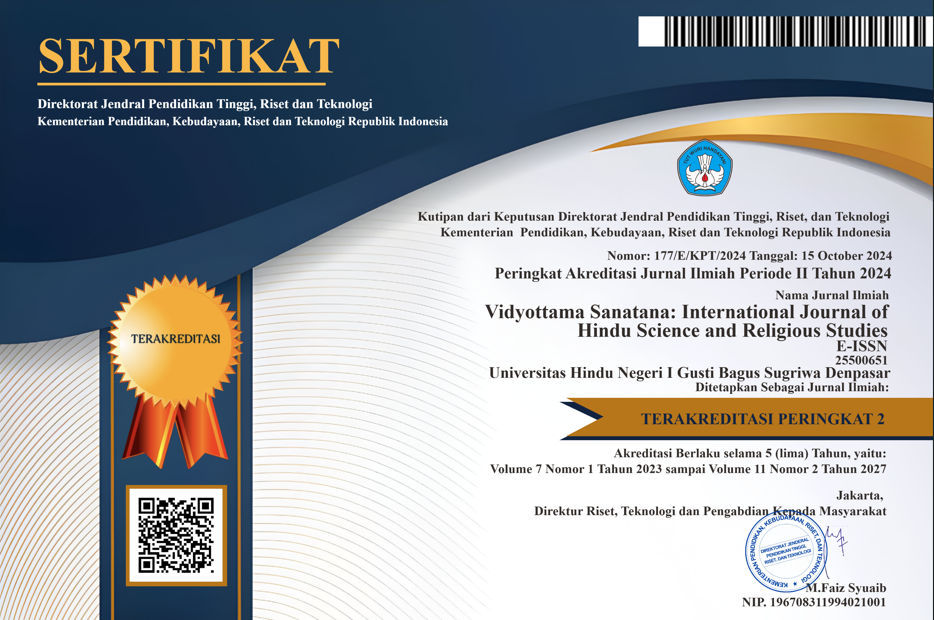
THE EXISTENCE OF TRADITIONAL VILLAGES IN THE STATE CONSTRUCTION OF THE REPUBLIC OF INDONESIA
DOI:
https://doi.org/10.25078/vidyottama.v9i2.2361Abstract
This study aims to analyze the existence of the Traditional Village in the Provincial Government of Bali. This research was conducted in two districts in Bali, namely Bangli and Karangasem. Data collection in this study was carried out through observation, in-depth interviews, and documentation studies. Based on the research conducted, it was found that, the differences in the structure of traditional village leaders can be described in two types, namely the traditional village version of the leadership structure of the Bali Aga traditional village and the version of the Balinese Majapahit traditional village. The Bali Aga traditional village referred to in this study is the Tenganan Pagringsingan Traditional Village, Manggis sub-district, Karangasem district, and the Batur Traditional Village, Kintamani Bangli, representing the Bali Aga Traditional Village. Meanwhile, the Kubu Traditional Village, Bangli District, Bangli Regency, and Karangasem Traditional Village, Karangasem District, Karangasem Regency, represent the Balinese Majapahit/apanage traditional village. Bali Aga traditional villages are found in the mountainous areas of the Bangli, Karangasem, Tabanan, and Singaraja districts. Regarding the term Bali Mula Traditional Village or Bali Aga, Balinese customary law experts still do not have an agreement as a unified word term for the name of the Traditional Village whether it is Bali Aga/Bali Mula, Bali Apanaga, and so on. In this research, the name used for the term Balinese Traditional Village as it is found in the area mentioned above is the Bali Aga Traditional Village. Meanwhile, villages other than Bali Aga Village are called Bali Apanaga.
References
Ahmad Tafsir, 2006. General Philosophy; Mind and Heart From Thales to Capra. Bandung. Rosda Karya
Article "Cultural hegemony", Friday, September 11, 2009, on the website http://irapurwitasari.blog.mercubuana.ac.id/author/hegemoni-buda
Article " Gramsci's Hegemony Theory", Saturday, October 17, 2009, on the website http://valasiseng.blogspot.com/2009/10/teori-hegemony-gramsci.html
Atmaja, Gede Marhaendra Wija. 2012. “The Politics of Legal Pluralism in the Recognition of Indigenous Peoples with Regional Regulations. Doctoral Dissertation. Malang: Faculty of Law, University of Brawijaya.
Atmaja, Gede Marhaendra Wija. 2016. The Politics of Legal Pluralism: Directions for Recognition of Indigenous Peoples with Regional Regulations. Denpasar: Publisher PT Printing Bali.
Atmaja, Gede Marhaendra Wija. 2019. "The Origins of Traditional Villages: Early Experiences and Conceptual Arrangements for Traditional Villages in Bali". Denpasar: Faculty of Law, Udayana University.
Budiman, Arief (Ed.). 1999. State and Civil Society in Indonesia. Monash: Monash Papers on Southeast Indonesia.
Dijk, R. Van. 2006. Introduction to Indonesian Customary Law. Bandung: CV Mandar Maju Publisher.
Doli D. Siregar, Asset Management, Strategies for Structuring the Concept of National Development in the Context of Regional Heads as CEOs in the Era of Globalization and Regional Autonomy (Jakarta, PT. Gramedia Pustaka Utama, 2004)
Dresta, Wayan, 2003. Awig Kuna Karangasem customary village. Karangasem, collection of I Gusti Agung Bagus Cakra.
Foucault, Michel 1977. Discipline and Punishment: The Birth of the Prison (Alan Sheridan's translation). New York: Vintage Books.
Foucault, Michel. 1980. Power/Knowledge, Selected Interviews and Other Writings 1972-1977 (C Gordon, Ed.). New York: Pantheon.
Gramsci, Antonio. 1971. Selections from Prison Notebooks. New York: International Publishers.
Hamidi. 2005. Qualitative Research Methods: Practical Applications in Making Proposals and Research Reports. Malang: UMM PRESS
Hendra Nurtjahjo and Fokky, 2010. Legal Standing of Indigenous Peoples Unity in Cases at the Constitutional Court, Jakarta: Selemba Humanika Publisher, 2010.
http://irapurwitasari.blog.mercubuana.ac.id/author/hegemoni-daya/
http://valasiseng.blogspot.com/2009/10/teori-hegemony-gramsci.html
Janamijaya, I Gede, Wiraatmaja, I Nyoman et al., 2003, The Existence of Traditional Villages in Bali, Tri Hita Karana Bali Foundation , Denpasar.
Kaler, I Gusti Ketut, 1983. Scattered Points about Balinese Customs . Denpasar, Bali Agung.
Kartodirjo, Sartono. (1982), Thought and Development of Indonesian Historiography An Alternative. Jakarta: Gramedia
Koentjaraningrat. 1994. Community Research Methods . Jakarta: Gramedia Pustaka Utama
Koesnoe, H. Moh. 1992. Customary Law as a Legal Model. Part I (Historical. Bandung: CV Mandar Maju Publisher.
Lorens Bagus, 2005. Dictionary of Philosophy, Jakarta, Gramedia Pustaka Utama.
Marzuki. 1987. Research Methods. Jakarta: BPFC
Munandar Asher Sunyato, 2008. Psychology and Organization. Jakarta. The University of Indonesia UI publisher. press
Nezar Patria, Antonio Gramsci Negara & Hegemony, (Yogyakarta: Student Library. 1999) p. 116
Nezar Patria. Antonio Gramsci State & Hegemony, (Yogyakarta: Student Library. 1999) Article " Gramsci's Hegemony Theory", Saturday, October 17, 2009, on the website http://valasiseng.blogspot.com/2009/10/teori-hegemoni-gramsci.html Article "Cultural hegemony", Friday, 11 September 2009, on the website http://irapurwitasari.blog.mercubuana.ac.id/author/ hegemony-culture
Nurjaya. Nyoman, 2020. Understanding the Capacity of Customary Law in the Politics of National Law Development, in Windia, 2020. Denpasar Udayana University Press
Oartohadikoesoemo, Soetardjo. Village. Jakarta: PN Balai Pustaka. 1984.
Panghoeloe, Rasjid Manggis Dt. Radjo. 1982. A Brief History of Minangkabau and Its Customs. Jakarta: Pearl Publisher.
Pangringsingan, Manggis District, Karangasem Regency, Bali Province, 2021 Reporting Period. Bali. Balinese Traditional Village Council.
Parimartha, I Gde. 2013. Cross -View of Adar Village and Service Village in Bali. Denpasar. Udayana UniversityPress.
Piliang, Yasraf Amir. 2004. The Folded World: An Excursion Beyond Cultural Boundaries. Yogyakarta: Jalasutra.
Raka, I Gusti Gde. 1955. Monograph of the Island of Bali. Jakarta: Published by the Publication Section of the People's Agriculture Service Center.
Reflective Essay: The Thoughts of Thomas Hobbes, John Locke, and JJ Rousseau in the Social Contract Idea
Sidi Gazalba. 1981. Introduction to History as a Science. Jakarta: Bhrata Karya Script
Spradley, James P. 1997. Ethnographic Methods. Yogyakarta: PT Tiara Wacana Yogya.
Suarna, Nyoman, 1933. Awig-Awig Traditional Village of Tenganan Pagringsingan Karangasem. Karangasem, Headquarters of Tenganan Village
Sudantra, Kt, 2020. Customary justice in Indonesia, its existence and relevance, in Windya, 2020. Denpasar, Udayana University Press.
Sukadia, I Wayan, 2017: Ulun Danu Batur Temple at a Glance. Kintamani. Batur Traditional Village.
Sumarta Kt, 2020. Management of Traditional Villages in Bali, in Windia, 2020. Denpasar Udayana University Press
Sumarta Kt. 2021. Determination and recognition of prajuru of the Tenganan Traditional Village
Surpha, I Wayan Surpha. 2004. Existence of Traditional Villages and Service Villages in Bali. Denpasar: Bali Post Library.
Syafrudin, H. Ateng and Suprin Na'a. 2010. Republic of the Village: Traditional Law Struggles and Modern Laws in Village Autonomy Design. Bandung: Alumni Publisher.
Tim, 2001. Awig-Awig Karangasem Traditional Village, Karangasem. Karangasem Traditional Village
Team, 2018. Awig-Awig Batur Traditional Village, Bangli, Batur Traditional Village
Team. 2009. Awig-Awig Kubu Traditional Village Bangli, Bangli, Kubu Traditional Village.
Tjokkorda Rai Sudharta, 1995, Manawadharmasastra , Jakarta: PT. Hanuman Sakti.
Veeger, KJ 1986 Social Reality , Jakarta: PT. Gramedia
Widja, I Gde. 1989. Fundamentals of Strategy Development and Methods of Teaching History. Jakarta: P2LPTK.
Wija atmaja, Mahendra Gd, 2020. Traditional Village as a Traditional Law Unit in Bali. In Windia, 2020, Denpasar, Udayana University Press
Winarno Surakhmad. 1994. Introduction to Basic Scientific Research and Engineering Methods. Bandung: Tarsito
Windia.P. Wayan. 2017: Various Cases of Balinese Customary Law and their Settlements, Denpasar, PT Aksara
Windia.P. Wayan. 2004. Danda Pacamil, notes on popular terms of Balinese customary law, Denpasar. PT Upadasastra.
Windya, P. Wayan, 2020. Customary Law and Traditional Villages in Bali, Bali. Udayana UniversityPress.
Wulansari, Katrina Dewi, 2020. History and Legal Basis for the Application of Customary Law in Indonesia, in Windya, 2020. Denpasar, Udayana University Press.
Zamroni, 2005. The Future Education Paradigm . Bigraph Publishing, Yogyakarta.