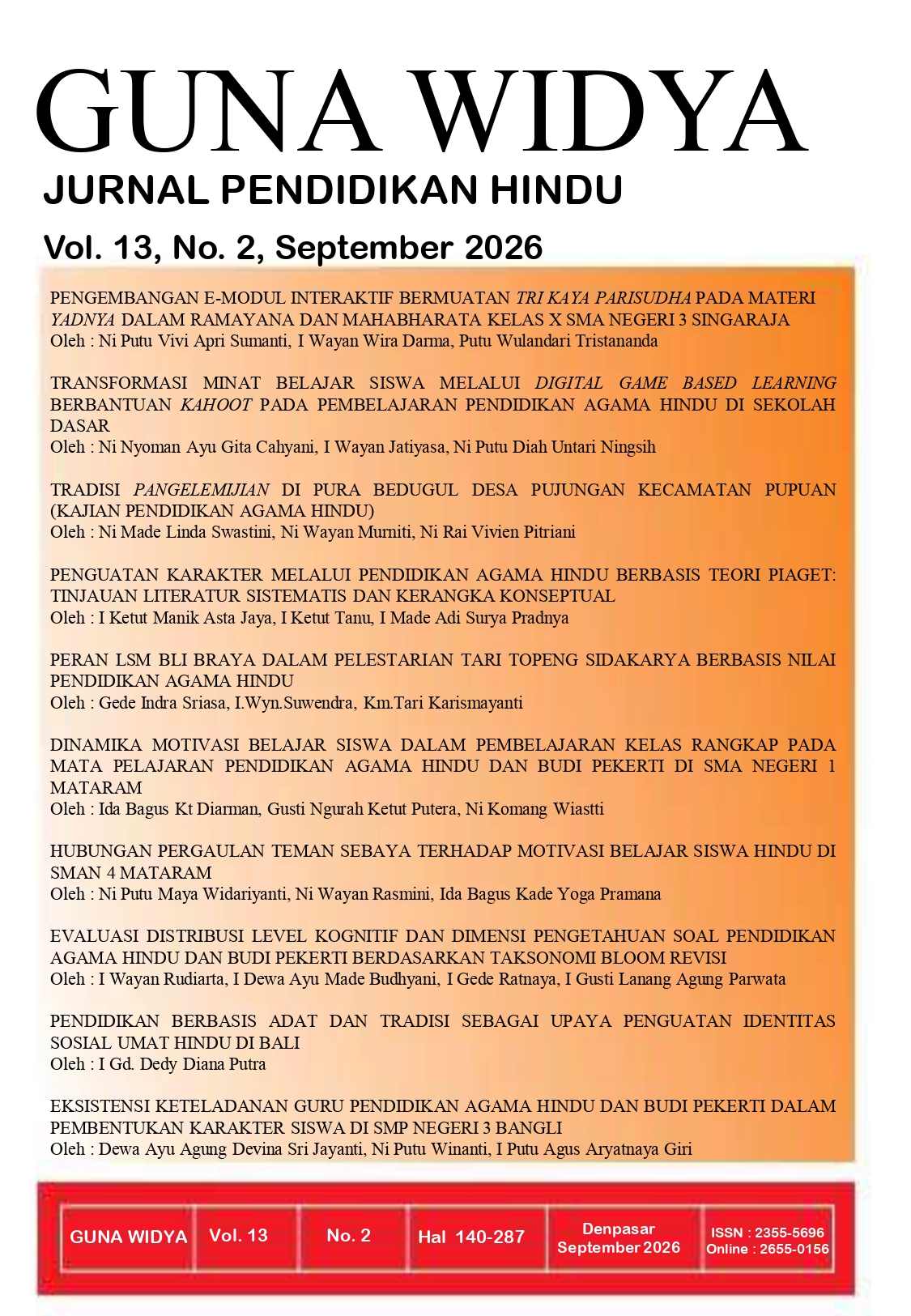
PENGUATAN KARAKTER MELALUI PENDIDIKAN AGAMA HINDU BERBASIS TEORI PIAGET : TINJAUAN LITERATUR SISTEMATIS DAN KERANGKA KONSEPTUAL
DOI:
https://doi.org/10.25078/gw.v13i2.7117Kata Kunci:
Pendidikan Agama Hindu, Karakter, Jean PiagetAbstrak
This study aims to examine the application of Jean Piaget’s theory of cognitive development
in Hindu Religious Education as a means to strengthen students' character. Employing a
qualitative approach via a literature review, the study analyzes the relationship between
Piaget’s cognitive development stages sensorimotor, preoperational, concrete operational,
and formal operational and Hindu Religious Education strategies that foster the
internalization of character values. The findings indicate that the effectiveness of character
strengthening is significantly influenced by the alignment of teaching strategies with
students' cognitive development levels. At the sensorimotor stage (ages 0–2), character
formation is primarily achieved through the habituation of positive behaviors and religious
experiences involving sensory stimulation. Upon entering the preoperational stage (ages 2–
7), instilling values such as Tri Kaya Parisudha and Tat Twam Asi becomes more effective
when conveyed through storytelling, role-playing, and symbolic activities suited to children's
developmental characteristics. Subsequently, during the concrete operational stage (ages 7–
12), character traits such as discipline, responsibility, and social concern can be cultivated
through tangible learning experiences such as ngayah (communal service) and
environmental conservation activities grounded in the Tri Hita Karana concept. Meanwhile,
at the formal operational stage (ages 12 and up), the emergence of abstract thinking abilities
enables students to critically reflect on Hindu teachings—such as dharma, karma, and
moksha through the analysis of moral dilemmas, philosophical discussions, and complex
problem-solving. The study concludes that a developmentally appropriate approach allows
students to construct an understanding of religious values in a gradual, meaningful, and
sustainable manner. Integrating Piaget’s theory into Hindu Religious Education contributes
significantly to shaping students who possess intellectual intelligence, moral maturity,
spiritual awareness, and a character aligned with Hindu values, while simultaneously
addressing the challenges of moral degradation in the modern era through the synergy of
formal education, family, and the community.