ACCREDITATION

Sphatika: Jurnal Teologi [Sphatika: Journal of Theology] is a peer-reviewed, open-access journal devoted to the scholarly study of theology across religious traditions. Published by Universitas Hindu Negeri I Gusti Bagus Sugriwa Denpasar and managed by the Department of Hindu Theology, the journal provides a forum for original research and critical reviews on Hindu, Christian, Islamic, Buddhist, and other theologies, as well as on religious studies, religious literature, and the cultural expressions of religion. Taking its name from sphaṭika, the clear crystal that reflects light without distortion, the journal aspires to present religious knowledge with clarity, rigour, and integrity, so that each tradition may be understood in its own terms and in dialogue with others. While Sphatika holds a particular strength in the Hindu textual and ritual heritage of Bali and the wider Nusantara, it is equally committed to theological inquiry from every faith tradition, and welcomes contributions from scholars of all backgrounds working in confessional, comparative, and interdisciplinary perspectives.
| Journal Title | Sphatika: Jurnal Teologi English parallel title: Sphatika: Journal of Theology |
| Initials | Sphatika |
| DOI Prefix | 10.25078 — registered through Crossref Article DOI pattern: 10.25078/sphatika.v[volume]i[issue].[id] |
| Publication Frequency | Two issues per year (March and September) |
| Online ISSN | 2722-8576 |
| Print ISSN | 1978-7014 |
| Editor-in-Chief | Ida Bagus Subrahmaniam Saitya ORCID | Google Scholar |
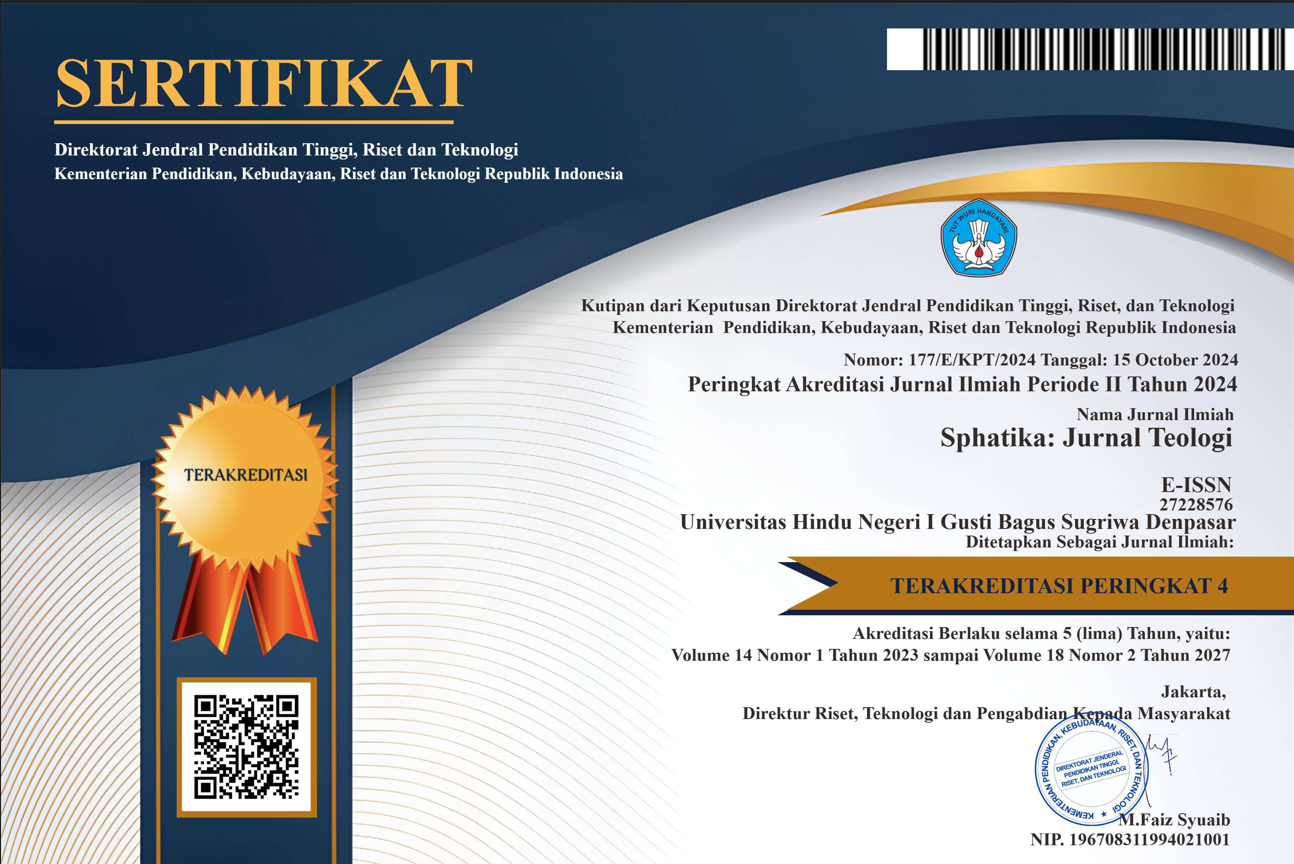
| National Accreditation | SINTA 4 Accredited from Vol. 14 No. 1 (2023) to Vol. 18 No. 2 (2027) under the Decree of the Director General of Higher Education, Research, and Technology, Ministry of Education, Culture, Research, and Technology No. 177/E/KPT/2024. |
| Indexing and Discovery | SINTA, Garuda, Crossref, Dimensions, Base, OneSearch, OpenAlex, and Google Scholar. |
| Publisher | Universitas Hindu Negeri I Gusti Bagus Sugriwa Denpasar, managed by the Department of Hindu Theology. |
| Language | Bahasa Indonesia and English (abstracts in both languages) |
| Peer Review | Double-blind peer review |
| Article Processing Charge | None — no submission or publication fees |
| License | Creative Commons Attribution-NonCommercial-ShareAlike 4.0 International (CC BY-NC-SA 4.0) |
| Similarity Check | All manuscripts are screened for plagiarism before review (maximum similarity: 20%) |
Sphatika publishes research articles and scholarly reviews that deepen the understanding of theology as both a body of sacred knowledge and a lived practice within religious communities. The journal is open to studies from Hindu, Christian, Islamic, Buddhist, Confucian, and indigenous religious traditions, whether written from within a tradition or from a comparative standpoint. It gives particular attention to the religious life of Indonesia and Southeast Asia, where many traditions meet, while also welcoming studies from other regions. The journal is intended for academics, researchers, lecturers, students, religious leaders, and practitioners of theology, religious studies, and religious education. Its scope covers four interrelated fields, with topics of interest including, but not limited to:
1. Theology
2. Religious Studies
3. Religious Literature
4. Cultural Studies of Religion
The journal welcomes manuscripts that are original, methodologically sound, and grounded in primary sources or fieldwork, and that offer clear theoretical or practical contributions. Manuscripts that are purely devotional, normative without analysis, or outside the scope above will not be sent for review.
Sphatika does not charge authors any fees at any stage of publication. There are no submission fees, no article processing charges (APC), and no publication fees. All costs of editing, peer review, layout, DOI registration, and online hosting are fully covered by Universitas Hindu Negeri I Gusti Bagus Sugriwa Denpasar. Acceptance of a manuscript is based solely on its scholarly quality and never on any payment.
Sphatika recognizes that generative AI tools can support scholarly writing, but their use must be transparent, limited, and accountable. This policy follows the COPE position statement on authorship and AI tools.
For Authors
For Reviewers and Editors
Undisclosed or inappropriate use of AI tools discovered before or after publication will be handled in accordance with COPE guidelines and may lead to rejection, correction, or retraction of the article.
Sphatika provides immediate open access to all of its content, on the principle that making research freely available to the public supports a greater global exchange of knowledge. Readers may read, download, copy, distribute, and cite the articles for non-commercial purposes, provided the original work is properly attributed, in accordance with the CC BY-NC-SA 4.0 license.
To guarantee long-term access to its content, Sphatika preserves all published articles through the PKP Preservation Network (PKP PN), which uses LOCKSS technology to create permanent, distributed archives. In the event that the journal ceases publication, its content will remain accessible through the network. In addition, every article is assigned a Crossref DOI, is stored on the servers of Universitas Hindu Negeri I Gusti Bagus Sugriwa Denpasar, and is indexed in national databases including Garuda and Moraref.
Sphatika adheres to the guidelines of the Committee on Publication Ethics (COPE). All parties involved in the publication process — publisher, editors, reviewers, and authors — are expected to uphold three core values: impartiality (freedom from conflicts of interest), fairness (granting authorship only to those who have earned it), and honesty (freedom from duplication, fabrication, falsification, and plagiarism).
Our Commitment
Double-blind peer review. Immediate open access. No author fees. Published twice a year, in March and September. Every article receives a Crossref DOI.
Editorial Team | Reviewers | Author Guidelines | Article Template | Archives | Privacy Statement | Contact
ACCREDITATION
VISITOR STATISTIC

ARTICLE TEMPLATE


SUGGESTED TOOLS

INDEXING





PARTNERSHIP


This Journal is Published by:

Universitas Hindu Negeri I Gusti Bagus Sugriwa Denpasar
Jalan Ratna Nomor 51, Denpasar, Bali 80237, Indonesia
E-ISSN 2722-8576 & P-ISSN 1978-7014
Platform and Workflow by:

This work is licensed under a Creative Commons Attribution-NonCommercial-ShareAlike 4.0 International License (CC BY-NC-SA 4.0).