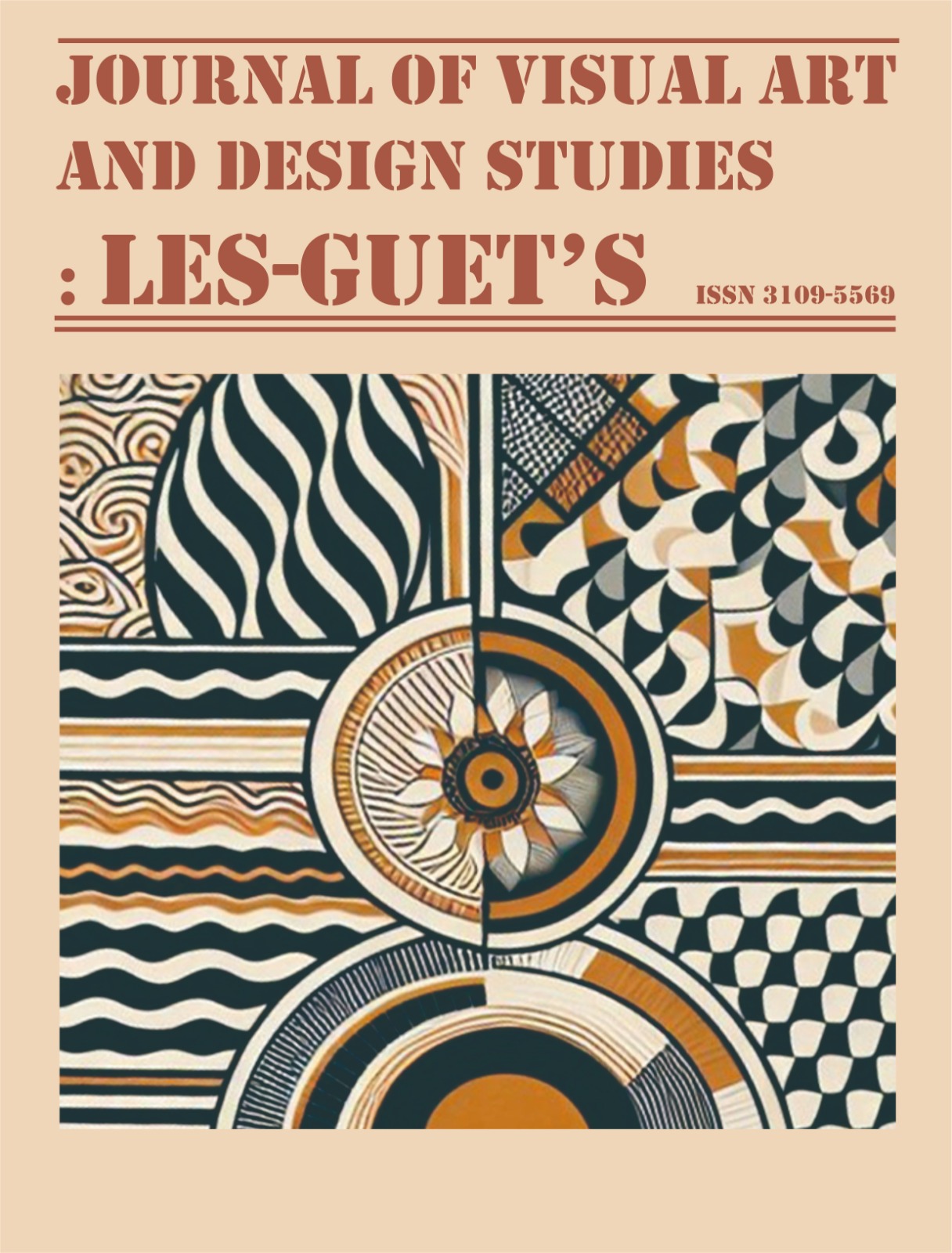
VISUALIZING ECOLOGY THROUGH TRADITION: A BIOPHILIC INTERPRETATION OF BALINESE GANGGONG ORNAMENT FOR CONTEMPORARY ENVIRONMENTAL COMMUNICATION DESIGN
DOI:
https://doi.org/10.25078/lg.v2i2.7673Keywords:
Ganggong Ornament, Balinese Ornamentation, Biophilic Design, Visual Metaphor, Environmental Communication Design, Visual InterpretationAbstract
This study examines the potential of Balinese Ganggong ornamentation as a conceptual resource for contemporary environmental communication design using biophilic design concepts and visual metaphor theory. Employing qualitative visual analysis, the study investigates a single author-produced Ganggong reinterpretation created in 2025 with reference to ornamentation on a pelinggih kemulan. The analysis addresses formal visual characteristics, nature-referential attributes, possible ecological metaphorical associations, and conceptual design implications. The findings identify coiled leaf forms, curvilinear contours, rhythmic repetition, and figure-ground relationships that can be interpreted in relation to biomorphic forms and patterns. Selected vegetal configurations and repeated ornamental units also provide possible associations with growth and continuity. These associations are treated as researcher-proposed interpretations rather than established cultural meanings or empirically confirmed audience responses. Building on these findings, the study proposes Biophilic Indigenous Visual Communication (BIVC) as a preliminary, case-derived interpretive framework connecting documented ornamental context, formal observation, qualified ecological interpretation, and conceptual design translation. Potential applications include modular campaign identity elements, nature-referential infographic framing, and motion graphic sequencing. The study proposes a structured interpretive approach for examining culturally situated ornamentation as a potential design resource without claiming demonstrated biophilic perception, increased environmental awareness, or communication effectiveness.
References
Artha, I. G. A. I. B., & Nuriarta, I. W. (2019). Bentuk, Fungsi Dan Makna Ornamen Pada Gamelan Semar Pegulingan Saih Pitu Di Pusat Dokumentasi Seni Institut Seni Indonesia Denpasar. Segara Widya : Jurnal Penelitian Seni, 7(2), 93–103. https://doi.org/10.31091/sw.v7i2.819
Browning, W. D., Ryan, C. O., & Clancy, J. O. (2024). 14 Patterns of Biophilic Design.(10th Anniversary Edition (10th ed.). Terrapin Bright Green, LLC. https://www.terrapinbrightgreen.com/report/14-patterns/
Duan, R., Takahashi, B., & Zwickle, A. (2021). How Effective Are Concrete and Abstract Climate Change Images? The Moderating Role of Construal Level in Climate Change Visual Communication. Science Communication, 43(3), 358–387. https://doi.org/10.1177/10755470211008192
Forceville, C. (2017). Visual and Multimodal Metaphor in Advertising: Cultural Perspectives. Styles of Communication, 9(2), 26–41.
Forceville, C. (2024). Identifying and Interpreting Visual and Multimodal Metaphor in Commercials and Feature Films. Metaphor and Symbol, 39(1), 40–54. https://doi.org/10.1080/10926488.2023.2271544
Keating, D. M., & Skurka, C. (2024). Meta-Analytic Evidence That Message Fatigue is Associated With Unintended Persuasive Outcomes. Communication Research, 00936502241287875. https://doi.org/10.1177/00936502241287875
Mahadi, M., Ngidep Wiyasa, I. N., & Jaya Ck, I. G. N. A. (2022). Pelatihan Menggambar Ornamen Tradisional Bali di Panti Asuhan Yayasan Dharma Jati II Penatih Denpasar. Segara Widya : Jurnal Penelitian Seni, 10(2), 95–105. https://doi.org/10.31091/sw.v10i2.2153
O’Neill, S., & Nicholson-Cole, S. (2009). “Fear Won’t Do It”: Promoting Positive Engagement With Climate Change Through Visual and Iconic Representations. Science Communication, 30(3), 355–379. https://doi.org/10.1177/1075547008329201
Rose, G. (2023). Visual methodologies: An introduction to researching with visual materials. City Road, London, England Thousans Oaks, California : SAGE Publications Ltd. ©2023. https://doi.org/https://doi.org/10.4135/9781036231576
Salazar, G., Monroe, M. C., Ennes, M., Jones, J. A., & Veríssimo, D. (2022). Testing the influence of visual framing on engagement and pro‐environmental action. Conservation Science and Practice, 4(10), e12812. https://doi.org/10.1111/csp2.12812
Song, H., & So, J. (2023). Message fatigue beyond the health message context: A replication and further extension of So et al. (2017). Human Communication Research, 49(3), 339–344. https://doi.org/10.1093/hcr/hqad021
Utami, A., & Swari, N. L. G. N. (2021). Ornamen Tradisional Bali Pada Interior Bangunan Gedung Ksirarnawa Taman Budaya Bali. Jurnal Arsitektur ZONASI, 4(2), 167–180. https://doi.org/10.17509/jaz.v4i2.30950
Downloads
Published
How to Cite
Issue
Section
License
Copyright (c) 2026 Journal of Visual Art and Design Studies: Les-Guet's

This work is licensed under a Creative Commons Attribution-NonCommercial-ShareAlike 4.0 International License.
You are free to:
- Share — copy and redistribute the material in any medium or format
- Adapt — remix, transform, and build upon the material
- The licensor cannot revoke these freedoms as long as you follow the license terms.
Under the following terms:
- Attribution — You must give appropriate credit , provide a link to the license, and indicate if changes were made . You may do so in any reasonable manner, but not in any way that suggests the licensor endorses you or your use.
- NonCommercial — You may not use the material for commercial purposes .
- ShareAlike — If you remix, transform, or build upon the material, you must distribute your contributions under the same license as the original.
- No additional restrictions — You may not apply legal terms or technological measures that legally restrict others from doing anything the license permits.
Notices:
You do not have to comply with the license for elements of the material in the public domain or where your use is permitted by an applicable exception or limitation .
No warranties are given. The license may not give you all of the permissions necessary for your intended use. For example, other rights such as publicity, privacy, or moral rights may limit how you use the material.